Spring Bee Buildup: Why Colony Growth Follows Different Math
Spring bee colonies grow linearly, not exponentially, adding just 500-600 bees per day for 10 weeks. This single insight changes everything about spring management, from split timing to super placement to swarm prevention.

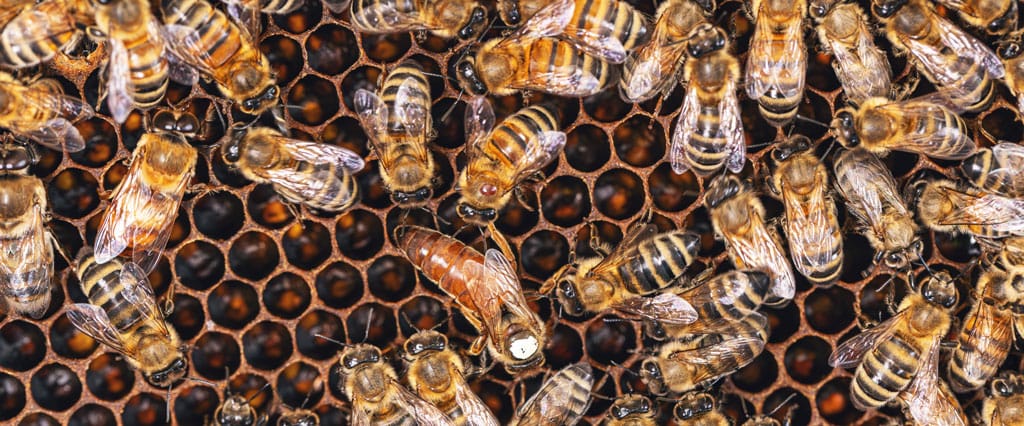
If you've been keeping bees for a while, you've probably noticed something odd about spring buildup. The colony doesn't explode in population the way you'd expect. You add frames, you see the queen laying steadily, but the actual growth feels slower than it should. Why is that? The spring colony growth operates on different mathematical principles than what most beekeepers assume. Let's take a closer look to better understand what that means.
The conventional wisdom treats bee colonies as exponentially growing organisms. More bees means more foragers, which means more resources, which means more brood, which means even more bees. It sounds logical. Right? It's also wrong, at least for spring.
Why Spring Colony Growth Is Linear, Not Exponential
Research and university extension programs reveal a counterintuitive finding: spring bee population growth is linear, not exponential. A healthy colony grows at approximately 500 to 600 bees per day for about 10 weeks, then plateaus. Not doubling. Not compounding. Just a steady, predictable addition of roughly the same number of bees each day.
Spring bee population growth is linear, not exponential.
This changes everything about spring management. If growth were exponential, you could wait until you saw signs of crowding and still have time to respond. With linear growth, your window for action is precise. The colony is on a fixed timeline, and that timeline started weeks before you notice the results.
Understanding the 42x Rule
One of the most useful concepts to emerge from colony dynamics research is what we might call the "42x Rule." A colony at maximum population will contain approximately 42 times its daily emergence rate. What does that mean? If 1,500 bees are emerging each day, the colony will peak at around 63,000 bees.
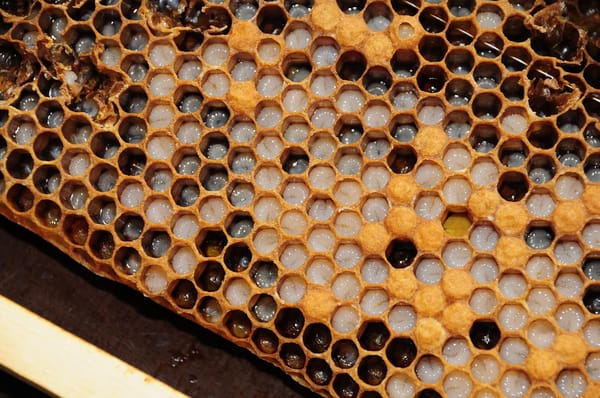
This isn't arbitrary. It comes directly from the worker development timeline: 21 days from egg to emergence (3 as an egg, 6 as a larva, 12 as a pupa), plus the average lifespan of a summer worker (roughly 21 more days of productive life). The colony size is limited by the number of bees that can be alive at once, given a constant production rate.
During spring buildup, that daily emergence rate is climbing toward its peak. The colony isn't getting exponentially larger because it can't. The queen can only lay so many eggs per day, and even a queen at peak performance is constrained by the physical reality of how fast she can move from cell to cell and how much the workers can feed her.
How Winter Bee Turnover Affects Spring Buildup
Spring presents a unique biological challenge: turnover. The winter bees that kept the cluster alive through cold months are aging out. These are physiologically different from summer bees, with larger fat bodies and distinct hormone profiles that enable them to live for months rather than weeks. They're the ones who must rear the first batches of spring brood, and they're running on borrowed time.
According to research from Mississippi State University, this turnover period is the most vulnerable time for a colony. If winter bees die before enough spring bees emerge to replace them, the colony can spiral downward even as the queen continues laying. You might see plenty of capped brood, but notice the adult bee population shrinking. The math isn't working out.
If winter bees die before enough spring bees emerge to replace them, the colony can spiral downward even as the queen continues laying.
That is why splitting too early in spring can be catastrophic. Pull frames of bees in late March or early April, and you might be removing the very winter bees needed to raise the next generation. The colony you're trying to build up might not have enough nurses to care for the brood the queen is laying.
What Limits Spring Colony Buildup
Spring colony growth isn't limited by just one factor. It's limited by whichever resource or capacity runs out first. There are several key constraints.
Pollen availability is perhaps the most critical. Young bees need pollen to develop their hypopharyngeal glands, which produce the royal jelly that feeds young larvae. Without adequate pollen, nurse bees can't feed brood properly, and the queen will reduce her laying rate, or workers will cannibalize eggs. You cannot substitute pollen with nectar or honey. The protein is non-negotiable.
Space is another hard limit. A queen needs empty cells to lay in, and if every frame is packed with nectar, honey, or capped brood, she has nowhere to go. This is why checkerboarding or adding frames at the right time matters. The goal isn't just to give the colony more room eventually but to ensure that empty, drawable comb is available exactly when the queen needs it.
Thermal capacity affects how much brood a given number of bees can keep warm. Early spring colonies with small clusters can't spread brood across ten frames because they can't maintain the 93°F to 95°F / 34°C to 35°C temperature that developing larvae need. The brood nest expands as the cluster grows, but it's a gradual process.
Nursing capacity is the limit most beekeepers underestimate. Young bees (roughly 3 to 11 days old) do the majority of brood feeding. If your colony doesn't have enough bees in that age range, brood rearing slows regardless of how much pollen you have or how many eggs the queen lays. This is the bottleneck that makes spring growth linear rather than exponential.
Timeline-Based Spring Management
So what does linear growth mean for actual hive management? It means you need to think in terms of fixed timelines, not flexible responses.
If you want strong colonies for a nectar flow that starts in mid-May, you need them to be building up by early March. That's 10 weeks of linear growth at 500 to 600 bees per day. If a colony starts spring with 10,000 bees and adds 550 bees per day for 70 days, it ends up with around 48,500 bees. That's respectable for early nectar flows, but it required the full 10-week runway.
Making spring splits requires the same backward planning. If you need a split to have field-ready foragers by June 1, and foragers are typically bees that are at least 21 days old, and those bees take 21 days to develop from eggs, you're looking at 42 days from the moment the new queen starts laying. Add in a week for queen mating and you need to make that split by mid-April at the latest. Plan to make splits 9 to 10 weeks before you need field bees from them.
Super management also changes when you accept linear growth. The old advice of "wait until the hive is bursting" leaves you constantly behind. A better approach is to add supers when frames are 70 to 80 percent occupied. The colony will fill that space at a predictable rate, and you want to stay just ahead of that rate, not scramble to catch up after the fact.
Swarm inspections need to happen every 14 days during swarm season, and swarm season itself is more predictable than many beekeepers realize. The key is tracking Growing Degree Days (GDD) rather than calendar dates. GDD measures accumulated warmth: each day, you take the average of the high and low temperatures, subtract a base temperature (usually 50°F / 10°C), and add the result to a running total starting January 1. A day with a high of 70°F (21°C) and a low of 50°F (10°C) contributes 10 degree days. A day that never gets above 50°F (10°C) contributes zero.
Research shows that colonies typically begin swarm preparations when GDD reaches 600 to 650. This varies by region, but it's far more accurate than calendar dates because it accounts for whether spring came early or late in any given year. Queen cells take about 16 days from egg to emergence, so a 14-day inspection cycle gives you one chance to catch cells before a swarm issues.
The Exponential Exception: Varroa Mites in Spring
One organism in your hive does grow exponentially during spring: varroa mites. While your bee colony is adding a fixed number of bees each day, varroa populations double at regular intervals when brood is present. A mite population of 100 in early April can become 3,200 by mid-June through exponential growth, even as the bee population is only increasing linearly.
This creates a dangerous mismatch. Beekeepers often assume that a booming spring colony can "handle" mites, waiting until summer to treat. The math doesn't support this. The mite population is growing faster than the bee population, and the ratio of mites to bees gets worse over time, not better. Spring is when you have your best chance to knock back mite numbers before they reach levels that cause real harm.
Managing by Timeline, Not Symptoms
The single biggest shift in perspective that linear spring growth requires is moving from reactive management to timeline-based management. You can't wait to see a problem before fixing it. By the time you notice the colony is running out of space, or lacks foragers, or is preparing to swarm, the math has already been running against you for weeks.
Spring is the season where doing the right thing at the wrong time is the same as not doing it at all. Feed pollen substitute in February if natural pollen isn't available, because the nurses being reared now will feed the foragers you need in April. Add space in late March, even if it looks like too much, because the colony will grow into it on a schedule that doesn't care whether you're ready. Make splits in mid-April if you want viable colonies by June, because the 21-plus-21 day development and maturation cycle is fixed.
The math of spring bee buildup is simple. It's linear, predictable, and unforgiving. A colony adds about 500 to 600 bees per day for 10 weeks. Every decision you make should account for where the colony will be weeks from now, not where it is today. As Wayne Gretzky put it: skate to where the puck is going, not where it's been. Once you start managing with that timeline in mind, everything from split timing to super placement to swarm prevention starts to make a whole lot more sense.